Proof of work · Programmable · Frozen since 21 October 2026
A foundation that doesn’t move
Ting is a general-purpose proof-of-work blockchain built as a permanent foundation. Its consensus is a small set of rules, written once and fixed for good: no developer, miner or foundation can change them. Coins, accounts, identities and fees are programs that anyone can deploy on top.
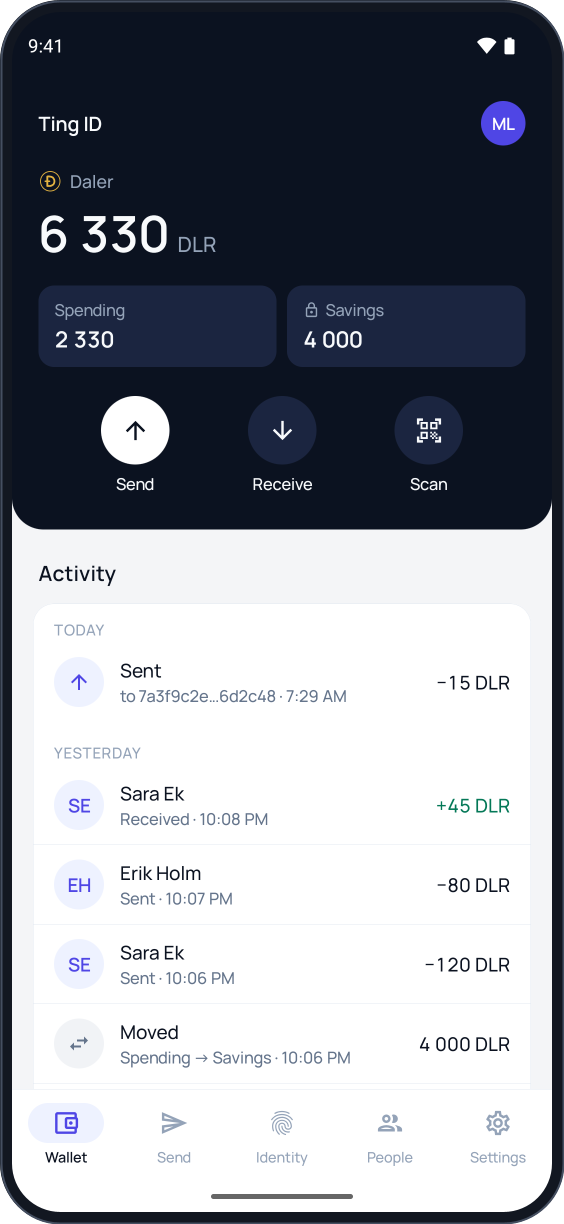
The wallet and identity app for Ting, on Android. Accounts, recovery and sign-in are not features of the chain: they are programs deployed on it, and Ting ID is one app that uses them.
Ting ID
A wallet and identity app · Android
An identity, not only a key. A Spending account for everyday payments, and a Savings account whose payments wait seven days and can be cancelled meanwhile.
Recovery that survives a lost phone. A twelve-word phrase, and guardians who can restore access or replace a phrase someone else got hold of.
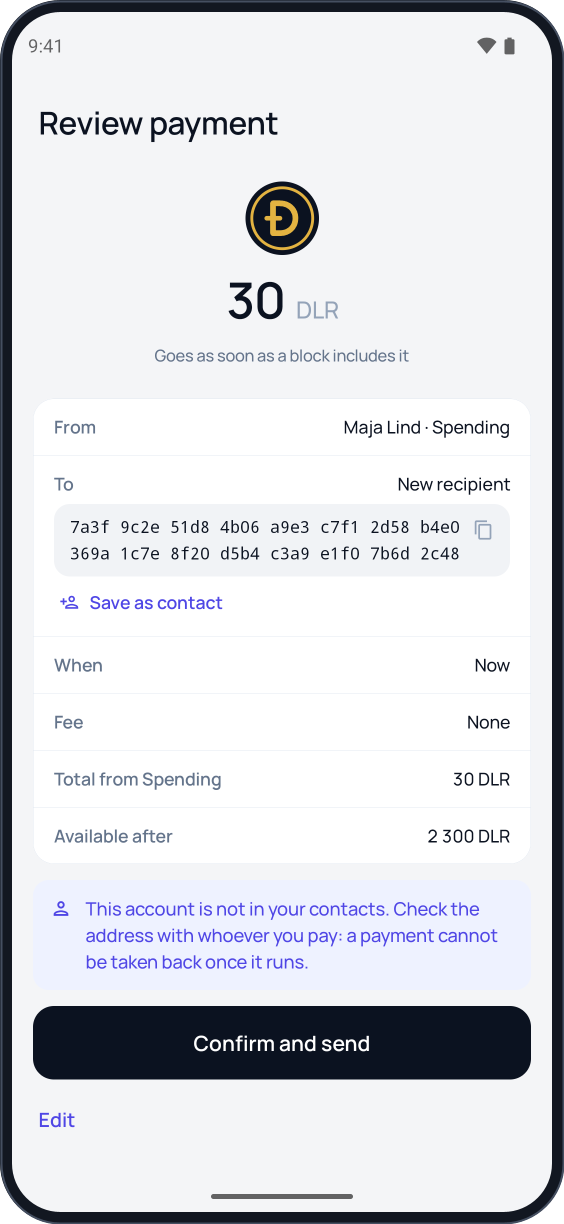
Any coin of the standard coin program. Send, schedule and cancel payments, by QR code or link, with fees set from what recent transactions paid.
One signature for sites and programs. Sign in without a password, and approve an action in a program in the program’s own words. The page holds no key.
It checks what it is told. Every record is checked against the block it comes from, and with two or more nodes each checks the others.
Ting ID is new software and still changing: keep in it only what you can afford to lose. It is one wallet built on the reference programs, not part of the protocol, and the miner has a wallet of its own, so mining needs no phone. The pictures are of a development chain with test identities.
02The protocol
Consensus does four things, and nothing else
On most programmable chains, a new signature scheme, opcode, fee rule or token standard is a protocol upgrade: every node changes together, and each change can alter what existing applications do or what they cost. Ting keeps its consensus small enough to state exactly, and then leaves it alone.
OneOrder
Transactions are ordered in blocks secured by SHA-256 proof of work.
TwoExecute
Programs run deterministically in a small, exactly specified WebAssembly profile.
ThreeCommit
Every block commits to its transactions, their receipts and the resulting state.
FourCount
Four independent counters bound the compute, state access, data and storage growth of every transaction.
Accounts, signatures, coins, fees, replay protection and upgrades are not on that list. They are programs, deployed and used through ordinary transactions. What is left fits in one document:
Freezing the rules only helps if independent implementations agree on every byte and every counter. Ting is built so that agreement can be checked, not assumed.
Builds for Linux (x86-64 and ARM64), macOS (Apple silicon and Intel) and Windows, where the command is .\ting.exe. Mining is solo, and an account from Ting ID can take the payout as well. MINER.md covers the wallet, the settings and the benchmarks.
Try it on a development chain
From a checkout of the ting repository, with Rust installed, a chain of your own to run, explore and build on:
The node serves its own explorer at http://127.0.0.1:18441/, with the wiki at /wiki and the REST API reference at /docs. Plain ting init joins the production network instead. Next: deploy a first program.
06Software
Everything that runs on Ting today
All of it is open source, under the MIT and Apache 2.0 licences. None of it is part of the protocol: any of it can be replaced by something better without asking anyone.
Wallet and identity
Ting ID
Wallet and identity · Android
Spending and Savings accounts, recovery through guardians, payments by QR code or link, and sign-in without a password, for any coin of the standard coin program.
The protocol and a node in Go, written from the rules document. It syncs from, serves and relays to reference nodes, and passes the reference’s conformance items.
A listing says what its maker gives and what they want; its coins wait in the program until someone takes it whole with Ting ID, or the maker withdraws it. No order book, no deposits and no balances.
Anyone paints it, pixel by pixel, and every paint burns coins. When the week ends the canvas locks for good and is auctioned; the winner owns it, to name, give away or sell.
Each is a program on the chain and a static page. The page holds no key and no coins: it reads the chain from a node and hands every action to the wallet as a link, so no server stands between the user and the program.
A public node
Block explorer
node1.ting-node.com
Blocks, transactions with their receipts and counters, contracts and their storage, the mempool and the network, as one of the network’s seed nodes sees them.
Every node can serve the same API, with storage answers that carry their proofs. The public node answers browsers from any origin, which is how this page reads its figures.
Ting has no native coin. Daler (DLR) is one deployment of the reference coin program, the same program anyone can deploy with their own name, supply and rewards. The chain does not know it exists and gives it no privilege; other coins can pay miners just as well.
Daler began with nothing issued: no premine, no allocations and no account that can mint. Every coin in existence was claimed as a reward by a mined block, and a block that names no payout account issues nothing. Its deployment is on the chain for anyone to read.
Ting is a young network and a small project. These are its weak points, stated plainly.
The network is small
Little hash power secures it so far, so someone who rents more could reorganize recent blocks. Wait for more confirmations than you would on a large network. More independent miners are what changes this.
Frozen means frozen
A flaw in the consensus cannot be patched in place. The answer to one that makes the chain unsafe is a new chain with its own genesis, which can carry the old chain’s state over. That is a coordination event, not something the protocol does by itself. Freeze consensus once
Two implementations, one maintainer
The Go node was written from the rules alone and agrees with the Rust node on every block, but both come from the same maintainer. An implementation written by someone else would be a stronger check, and is welcome.
Written with AI assistance
Much of the code was written with AI coding assistants under the maintainer’s direction. Expected results come from the written rules, never from the code under test, and the suite is part of the chain as its seed blocks. AI usage
Early software
The wallet and the miner are new. Desktop binaries are not code-signed: check each download against its SHA256SUMS and build attestation, or build from source, and keep in a wallet only what you can afford to lose.
Review is the point
The rules, the implementations, the tests and the vectors are public so that they can be checked. If something looks wrong or questionable, say so; a vulnerability goes through SECURITY.md.
Proof of work; nodes follow the heaviest valid chain
Proof of work
A single SHA-256 over Ting’s tagged block header, with a 16-byte nonce. It is not Bitcoin’s block format or double SHA-256, so Bitcoin ASICs cannot mine it and there is no merge-mining